Denture Rebase & Repairs in Duluth MN
A chipped denture tooth, damaged denture base, or the loss of a tooth supporting a partial denture can affect eating, appearance, and confidence. Repairs address specific damage or replace a missing tooth, while rebasing replaces the entire pink acrylic base when the existing denture teeth remain suitable. At Dental Implant & Reconstructive Center, we listen to your concerns, evaluate your prosthesis and oral health, and discuss treatment options with your needs and goals in mind. We welcome new and existing patients, including those whose dentures or implant prostheses were made elsewhere.
Dr. Roxanna J. Esguerra, a board-certified prosthodontist, works directly with our in-house laboratory team to evaluate the problem and plan appropriate care. This collaboration allows meticulous attention to the repair materials, appearance, fit, and function of your prosthesis. We take the time to assess the situation, explain your options, and complete the work carefully.
What Types of Repairs Do We Provide?
Following a clinical evaluation, treatment may include:
-
Complete denture repairs: Repairing damaged acrylic or replacing a chipped, broken, or detached denture tooth.
-
Removable implant “snap-in” denture repairs: Repairing the denture while accounting for its implant attachments.
-
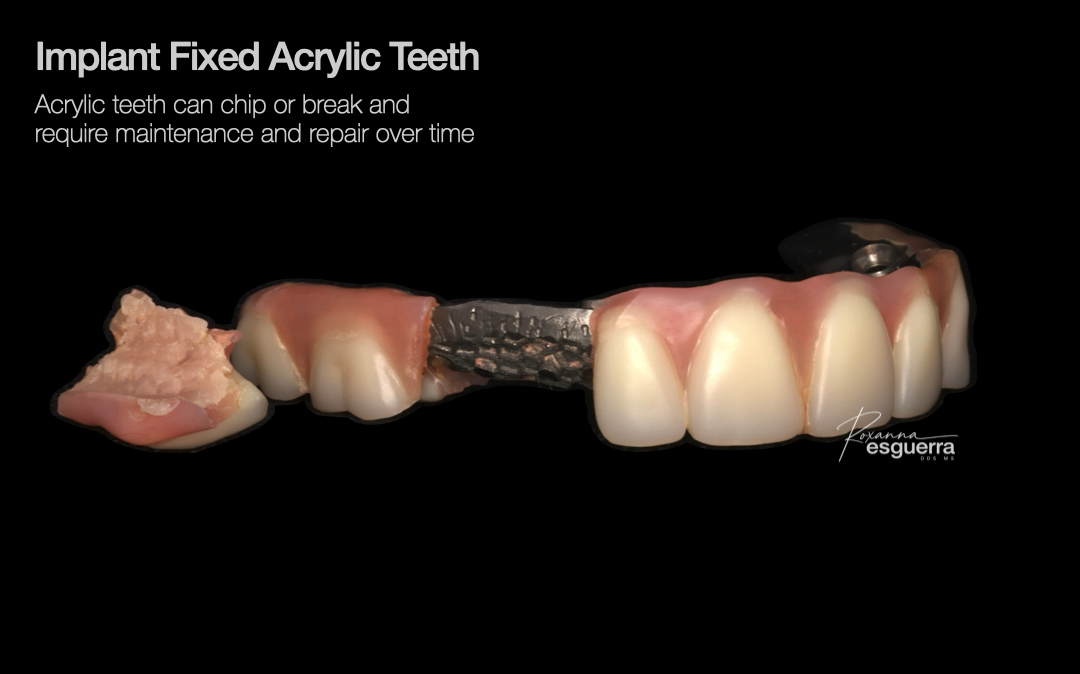
Fixed acrylic implant hybrid repairs: Repairing or replacing acrylic teeth in a full-arch prosthesis that stays in your mouth.
-
Adding a tooth to an existing partial denture: Modifying a suitable partial after the loss or planned removal of a natural tooth.
The appropriate procedure depends on your prosthesis, its condition, and the examination findings. Contact us when you first notice damage; same-day repair may be available with advance scheduling, depending on the treatment needed and availability.
Read more below about preparing for a repair visit at Dental Implant & Reconstructive Center , scheduling, and protecting your denture.
Need a Denture Repair?
We understand how important your teeth are to your comfort and confidence. Contact our team so we can help plan the appropriate evaluation and repair.
What Should I Do If a Tooth or Denture Breaks?
-
Save the broken tooth and all pieces. Bring them to your visit, even if they appear small or damaged. Reusing the original tooth, when possible, may help preserve the appearance of your smile.
-
Contact our office for instructions. Tell us what happened and whether you have pain, sharp edges, or difficulty wearing the prosthesis.
-
Avoid Superglue and store-bought repair kits for your final denture. Home repairs can alter the position of the pieces and make professional repair more difficult and costly.
-
Ask our team whether denture adhesive could help retain a removable denture temporarily while you await care. It does not replace a professional repair.
What Should I Tell the Team When I Call?
You do not need to know the technical name of your prosthesis. Our team will ask a few questions to help prepare for your visit:
-
Is it for your upper or lower jaw?
-
Does it come in and out, or does it stay fixed in your mouth?
-
Do you have dental implants?
-
Which tooth or part is chipped, loose, missing, or broken?
-
When did you first notice the problem?
-
Do you have a temporary or backup denture?
-
Do you have upcoming travel or an important event?
Photographs are required before scheduling a one-day repair appointment. Our team will explain what images are needed and how to send them. If you need help, we can arrange a visit to obtain photographs in our office, or schedule a separate clinical evaluation before planning the repair. This preparation helps us obtain the necessary materials and components and reserve adequate clinical and laboratory time. The examination determines the treatment recommendation.
Can My Denture Be Repaired in One Day?
Many routine repairs can be completed during a scheduled one-day repair appointment, depending on the treatment needed and clinical and laboratory availability. Allow approximately three hours total for many routine repair visits, including the examination, laboratory work, and clinical checks. You may wait in our office or leave and return at the arranged time. More involved repairs may require additional time or appointments.
We understand how important it is to look and feel your best for travel, family gatherings, and other events. Call when you first notice the problem, even if you can still wear the prosthesis. Contacting us early gives our team more opportunity to coordinate your care around those commitments. Waiting until shortly before departure or an event can limit the options available.
Why Does Every Repair Begin With an Examination?
Your repair begins with a clinical evaluation. Dr. Esguerra examines the fit, condition, and bite before confirming whether the proposed repair is appropriate. A chipped or detached acrylic tooth can be an expected maintenance need, particularly after years of function; it does not necessarily mean the entire prosthesis has failed. Published research recognizes tooth fracture and other maintenance needs in implant-supported prostheses.¹˒²
The examination helps distinguish an isolated repair from a problem that needs additional attention. Depending on the findings, Dr. Esguerra may assess tooth wear, tissue support, implant attachments, or your nightguard use. If a repair is unlikely to provide a satisfactory result, she explains the findings and discusses alternatives. This assessment is provided through a limited or problem-focused examination.
How Does Our In-House Laboratory Support Your Repair?
Our in-house laboratory allows direct collaboration between Dr. Esguerra and the technician completing your repair. Together, they consider material compatibility, tooth shape and color, and whether reinforcement or other changes are appropriate. Research shows that repair strength depends on factors such as the repair material and preparation of the existing denture.³ Careful finishing and polishing, followed by a clinical check of the repaired prosthesis, are also part of the process.
Different prostheses require different techniques. Flexible partial dentures, for example, use polymers that can make repairs or tooth additions less predictable. Dr. Esguerra evaluates the existing material and design before recommending treatment. Our goal is a repair that fits your clinical needs and preserves the appearance and function of your prosthesis whenever possible.
How Is a Fixed Acrylic Implant Hybrid Repaired?
A fixed acrylic implant hybrid stays in your mouth and requires professional removal for our laboratory repair process. Dr. Esguerra evaluates the damaged area, bite, and overall condition before carefully removing the prosthesis and transferring it to our in-house laboratory. Our laboratory team repairs or replaces the affected acrylic teeth or gum material, with attention to bonding, appearance, finishing, and polishing. Dr. Esguerra then reinstalls the prosthesis and checks its fit, bite, and screw connections before completing your visit.
This coordinated process gives our team access to the prosthesis for careful laboratory treatment and clinical verification afterward. The repair and time required depend on the damage and examination findings. Do not allow another provider to unscrew your fixed implant teeth without first coordinating with our office. These restorations require compatible instruments and knowledge of their components; damage to the screws or connections can make subsequent maintenance more complicated and costly. If you need care elsewhere, contact us so we can help coordinate it.
Can a Tooth Be Added to My Existing Partial Denture?
A tooth can often be added to a suitable partial denture after a natural tooth is lost or removed. We offer evaluation of partials made in our office or elsewhere and can coordinate an extraction with adding the replacement tooth when appropriate. The partial’s material, framework, fit, and condition determine whether this approach is feasible. Contact us before a planned extraction so we can evaluate the partial and coordinate the treatment sequence.
How Are Repair Fees and Appointments Arranged?
Before scheduling, our team prepares a preliminary treatment estimate based on the information available and asks you to review and sign it. The examination confirms whether the anticipated repair is suitable and whether additional treatment should be considered. If the findings change the proposed treatment or fees, we discuss that with you before proceeding. The preliminary estimate helps you plan while allowing the final recommendation to reflect the clinical findings.
Can Dropping My Denture Really Break It?
Yes—even a well-made denture can chip or break when dropped. Handle it over a folded towel or a sink lined with a washcloth, especially during cleaning. This provides a cushion if it slips from your hands. Keep removable dentures away from pets, and protect them during transport to your appointment.
We know how much your teeth matter to your daily life. Whether you have a small chip or a more involved concern, our team will help you understand your options and plan your care. Call (218) 722-8118—we’re here to help!
Why Do Repair Materials and Laboratory Techniques Matter?
A durable repair depends on more than filling a gap or attaching a tooth. The repair material, preparation of the existing acrylic, and processing technique influence how well the repair bonds and withstands bending forces. Laboratory studies have demonstrated differences between heat-cured, cold-cure, and light-cured repair materials, as well as the effects of preparing the surfaces before joining them.⁴˒⁵ These findings help guide material selection, while the condition and design of your prosthesis determine what is appropriate clinically.
For a detached denture tooth, retention depends on the relationship between the tooth and the surrounding acrylic. Preparation may include a bonding treatment or a small retention recess called a diatoric, which allows the acrylic to mechanically engage the tooth. JPD laboratory research found that a diatoric recess or an appropriate bonding agent improved retention compared with grinding alone in the tested repair system.⁶ Tooth preparation must also be considered in relation to the tooth and denture-base materials being used.⁷
Processing matters because acrylic can change dimensions as it hardens, potentially affecting fit and the bite. Research comparing compression molding, injection molding, and milling shows that outcomes vary with the materials and procedures studied.⁸–¹⁰ These findings reinforce the importance of selecting an appropriate technique and checking the prosthesis clinically after laboratory treatment. Laboratory strength and accuracy measurements inform care, but do not guarantee how long an individual repair will last.
Scientific References & Clinical Experience
Our recommendations combine published research with Dr. Esguerra’s clinical judgment and our in-house laboratory experience. Appointment timing, preliminary estimates, and scheduling procedures reflect our office’s approach to coordinating care.
-
Goodacre BJ, Goodacre SE, Goodacre CJ. Prosthetic complications with implant prostheses (2001–2017). European Journal of Oral Implantology. 2018;11(suppl 1):S27–S36.
-
Bidra AS, Daubert DM, Garcia LT, et al. Clinical practice guidelines for recall and maintenance of patients with tooth-borne and implant-borne dental restorations. Journal of Prosthodontics. 2016;25(suppl 1):S32–S40. doi:10.1111/jopr.12416.
-
Seó RS, Neppelenbroek KH, Arioli-Filho JN. Factors affecting the strength of denture repairs. Journal of Prosthodontics. 2007;16(4):302–310. doi:10.1111/j.1532-849X.2007.00191.x.
-
Alkurt M, Yeşil Duymuş Z, Gundogdu M. Effect of repair resin type and surface treatment on the repair strength of heat-polymerized denture base resin. Journal of Prosthetic Dentistry. 2014;111(1):71–78. doi:10.1016/j.prosdent.2013.09.007.
-
Shen C, Colaizzi FA, Birns B. Strength of denture repairs as influenced by surface treatment. Journal of Prosthetic Dentistry. 1984;52(6):844–848. doi:10.1016/S0022-3913(84)80016-5.
-
Meng GK, Chung KH, Fletcher-Stark ML, Zhang H. Effect of surface treatments and cyclic loading on the bond strength of acrylic resin denture teeth with autopolymerized repair acrylic resin. Journal of Prosthetic Dentistry. 2010;103(4):245–252. doi:10.1016/S0022-3913(10)60038-8.
-
Barpal D, Curtis DA, Finzen F, Perry J, Gansky SA. Failure load of acrylic resin denture teeth bonded to high impact acrylic resins. Journal of Prosthetic Dentistry. 1998;80(6):666–671. doi:10.1016/S0022-3913(98)70053-8.
-
Strohaver RA. Comparison of changes in vertical dimension between compression and injection molded complete dentures. Journal of Prosthetic Dentistry. 1989;62(6):716–718. doi:10.1016/0022-3913(89)90599-4.
-
Nogueira SS, Ogle RE, Davis EL. Comparison of accuracy between compression- and injection-molded complete dentures. Journal of Prosthetic Dentistry. 1999;82(3):291–300. doi:10.1016/S0022-3913(99)70083-1.
-
Einarsdottir ER, Geminiani A, Chochlidakis K, Feng C, Tsigarida A, Ercoli C. Dimensional stability of double-processed complete denture bases fabricated with compression molding, injection molding, and CAD-CAM subtraction milling. Journal of Prosthetic Dentistry. 2020;124(1):116–121. doi:10.1016/j.prosdent.2019.09.011.