IMPLANT “SNAP-iN” REMOVABLE DENTURES IN Duluth MN
What Is an Implant “Snap-In” Removable Denture?
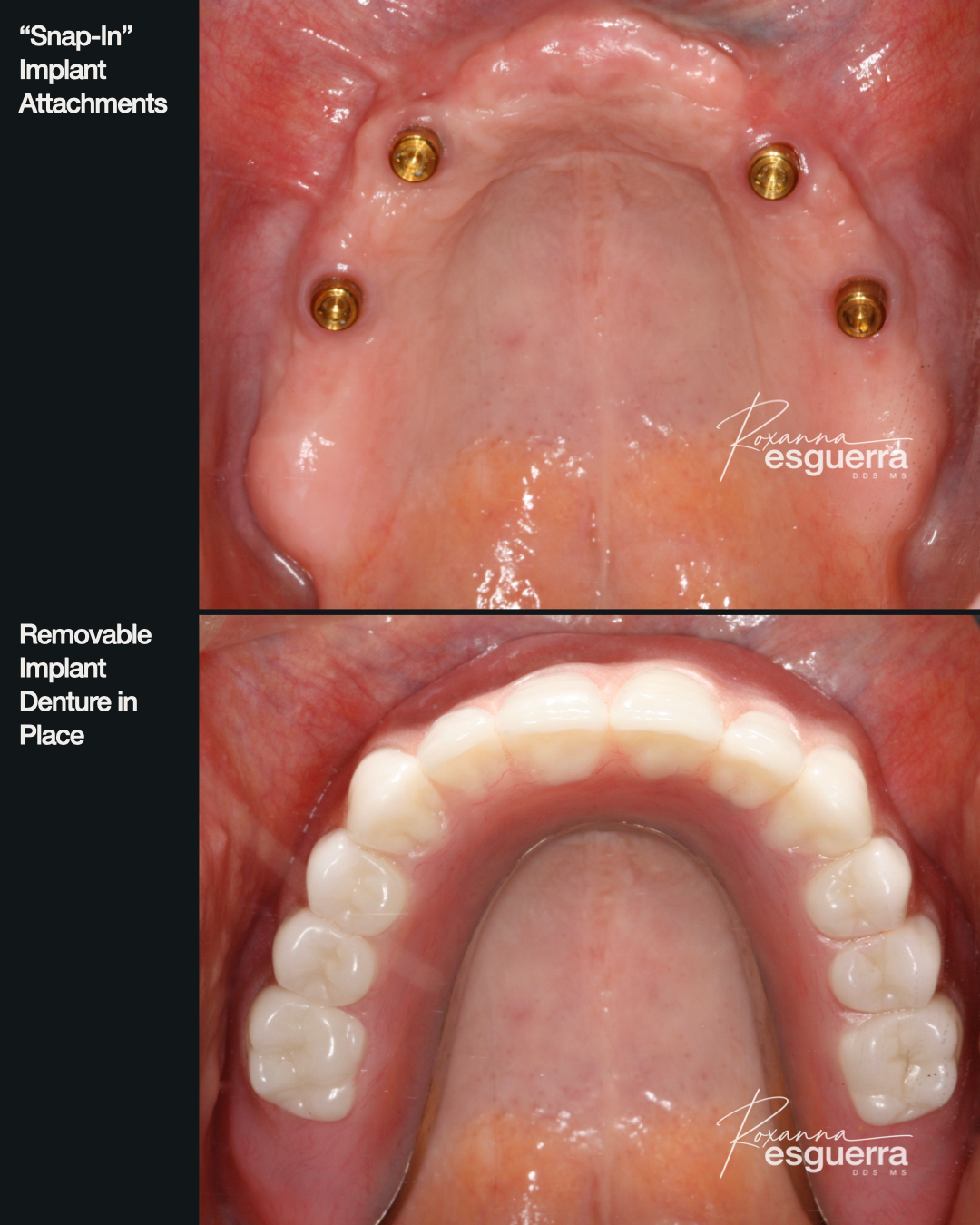
An implant “snap-in” removable denture is a dental prosthesis that attaches to dental implants for increased stability and retention. Unlike a fixed implant-supported prosthesis, it is designed to be removed by the patient, allowing access to clean the denture, implant attachments, and surrounding tissues.
Specialized attachment components connect the denture to the implants. These attachments help stabilize it during everyday function while allowing removal for cleaning.
At the Dental Implant & Reconstructive Center, care brings together the expertise of Dr. Roxanna J. Esguerra, a board-certified prosthodontist, the technical skill of our in-house dental laboratory, and a caring, knowledgeable team. Our recommendations reflect both clinical experience and published scientific literature.
Implant snap-in dentures require ongoing home care and professional maintenance. Understanding how your prosthesis is cleaned, adjusted, maintained, and repaired is an important part of understanding the treatment itself. This page is a long-term resource for patients considering, receiving, or currently living with an implant snap-in denture.
Home Care
Good home care helps protect your denture, implants, attachment components, and surrounding tissues. The following instructions reflect Dr. Esguerra’s recommended care protocol. Follow any individualized instructions provided for your particular prosthesis.
-
Remove and clean your denture every evening before bed. Clean the denture, implant attachments, and your mouth as described below.
-
Protect your denture while cleaning. Place a washcloth or hand towel in the bathroom sink to cushion it if it slips from your hand.
-
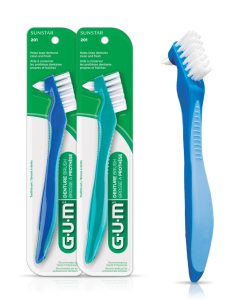
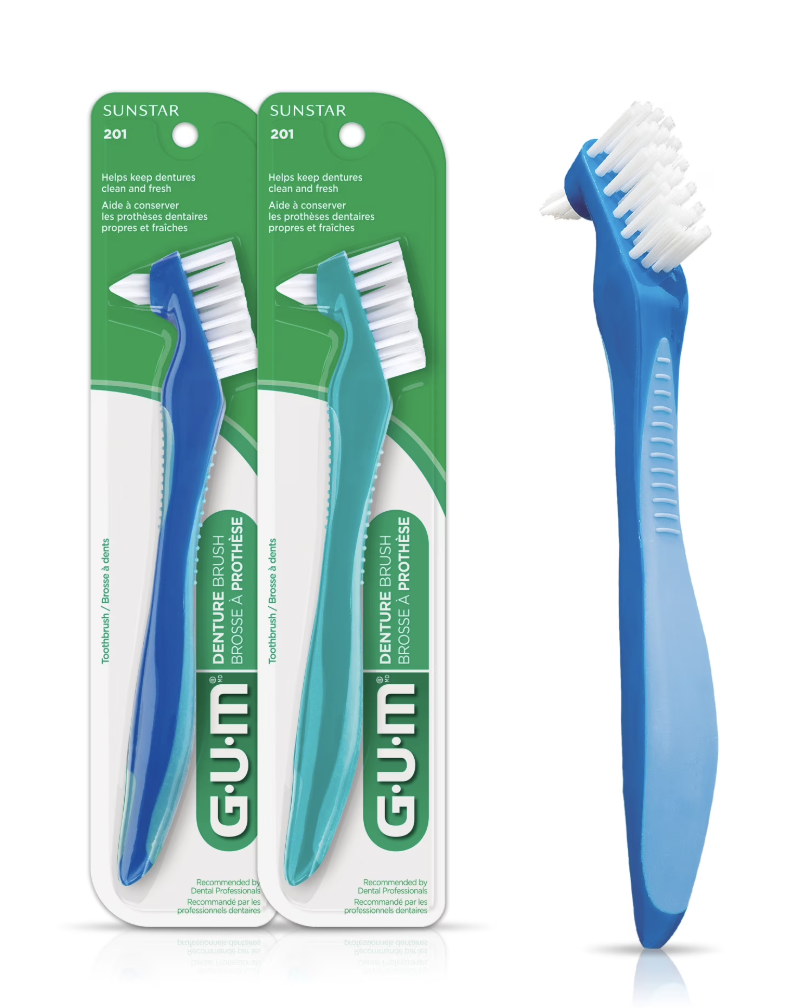
Brush all internal and external surfaces with a soft denture brush (see image right). Use a low-abrasive, non-whitening toothpaste formulated for sensitive teeth recommended by our team, such as an approved non-whitening Sensodyne formulation. This recommendation reflects decades of clinical experience caring for denture patients by Drs. Esguerra and Erickson. Mild liquid soap, such as dishwashing liquid, is an alternative. Clean the teeth, gum-colored surfaces, and internal surface, including around the attachment housings. Rinse thoroughly.
-
Avoid abrasive products and excessive heat. Whitening toothpaste, abrasive powders, and stiff brushes can scratch denture surfaces and make cleaning more difficult over time. Choose the specific toothpaste recommended by our team, since formulations vary. Use cool or lukewarm water—never very hot or boiling water.
-
Keep your denture in fresh water when you are not wearing it, unless we have provided different instructions. Keeping it moist helps protect against drying-related changes. Clean the container daily and replace the water each time. Plain water is for storage; it does not disinfect your denture.
-
Use an approved denture cleanser once a week to help control staining, unless our team recommends otherwise. Efferdent or a suitable Polident product may be appropriate, depending on your denture and attachment components. Use only the short soak recommended by our team—typically 10–15 minutes where permitted by the product instructions, or a shorter time if specified. Do not use overnight cleansers or soak overnight. Rinse thoroughly, then clean around the attachment components in the denture with mild soap and water. Our once-weekly recommendation is part of your clinical care protocol; cleanser ingredients and permitted frequency vary by product.
-
Clean your gums daily. Wrap a thin washcloth around your finger, moisten it with warm water, and gently wipe your gums and palate. This helps remove bacterial and fungal buildup, provides gentle tissue massage, and loosens any remaining denture adhesive. Gently clean your tongue as well.
-
Clean your implant abutments every day. These are the small titanium components visible above the gums. Use a water-moistened Q-tip or an end-tufted brush to clear away plaque and debris, following the technique demonstrated by our team. You may also use Superfloss in a gentle “shoe-shine” loop around the post, as instructed.
-
Keep your denture out of reach of pets. Store it in a protective container when it is not in your mouth.
-
Leave your denture out overnight. Nighttime wear promotes conditions associated with fungal (Candida) overgrowth and denture stomatitis—inflammation of the tissues beneath the denture.
-
Do not bite your denture into place. This can damage the retentive inserts and prevent the denture from snapping properly into position. Seat it using the technique demonstrated by our team.
-
Remove your denture evenly. Place your fingers on both sides and gently rock it away from the tissues and toward the front of your mouth, following the technique demonstrated for your attachments. Avoid pulling on only one side, which places unnecessary stress on the attachment components and prosthesis.
-
A Zest CHAIRSIDE® Denture Removal Tool may help with removal. These tools are generally inexpensive and available for purchase online. Ask our team whether one is appropriate and how to use it with your denture.
-
Rinse vegetables thoroughly before eating. Foods can carry naturally occurring or environmental abrasive particles. Leafy vegetables, including spinach, may retain grit after preparation. Thorough rinsing helps reduce abrasive debris.
-
Protect your denture from damage and avoid home repairs. Your implant snap-in denture is a precision prosthesis, but it may crack or break if dropped. Do not use Superglue or store-bought emergency repair kits. These materials may interfere with proper repair or fit and increase the eventual repair cost. Contact our office for evaluation and repair through our in-house dental laboratory.
-
An ultrasonic cleaner may supplement your routine. Ultrasonic devices use vibrations in liquid to help loosen deposits from denture surfaces. Ask our team which device and cleaning solution are appropriate for your denture and attachments. Follow the recommended cycle, rinse thoroughly afterward, and clean the device’s container after each use.
Regular Dental Care & Recare
Regular professional dental care remains important even when no natural teeth remain. Implants and implant prostheses require ongoing monitoring.
We evaluate the gums, implants and surrounding tissues, attachment components, and the denture’s fit, condition, and function. Our recommended care also includes an oral cancer screening at least once each year.
Patients with remaining natural teeth should continue regular cleaning visits with a dental hygienist.
Long-term care needs are individual. The recommended type and frequency of visits depend on your remaining teeth, prosthesis, implant and tissue health, and individual risk factors.
Dr. Esguerra makes a personalized recare recommendation for every patient. Your plan may include routine care with a general dentist, implant recare at DIRC, or a combination of both.
Adjustments & Sore Spots
Sore spots can develop with a new denture. In our clinical experience, anchoring a denture with implants often reduces soreness associated with movement, although adjustments may still be needed. Most patients in our practice require approximately two to three adjustments, but every patient is different.
The first two denture adjustments are included in the original treatment fee. Additional adjustments are charged per visit. We want you to understand what treatment includes and when separate fees may apply.
If significant pain or discomfort develops, remove the denture as needed for comfort and contact our office to arrange an adjustment.
If tolerable, wear your denture the day before your scheduled adjustment visit. This helps Dr. Esguerra identify the sore area and its relationship to the denture. If wearing it is too painful, leave it out and bring it to your appointment.
Maintenance of Attachment Components
Your implant snap-in denture connects to the implants through specialized attachment components. These components work together and, like other mechanical parts, wear over time.
If your denture begins to feel loose, a worn retentive insert may be the cause. This small, replaceable component sits within the attachment system and can often be replaced during a recare visit.
Looseness can have other causes, too. Dr. Esguerra evaluates the implants, attachment components, and prosthesis to identify the underlying issue before recommending treatment.
Routine maintenance is an expected part of caring for a removable implant prosthesis. It does not necessarily mean something has gone wrong with the implants or treatment.
Repairs
Your denture is placed and removed repeatedly during everyday use. This repeated function creates mechanical stresses within the prosthesis over time. Even a carefully designed and fabricated denture may need maintenance and occasional repair.
Understanding this before treatment helps you know what to expect. Implant dentures are sophisticated dental prostheses designed for everyday use, and their condition should be monitored so problems can be evaluated when they occur.
Tell our clinical team if your denture has broken in the same area more than once, or if a crack appears to be growing. Repeated or changing problems can provide important information about why the denture is breaking and may require further evaluation before repair.
Why Can’t I Just Drop Off My Denture for Repair?
A denture is a dental prosthesis—not simply an appliance being dropped off for repair. While we make every effort to coordinate repairs efficiently, denture repair involves both clinical care and laboratory procedures. Under Minnesota law, a dental laboratory cannot perform a denture repair without authorization from a licensed dentist.⁶
There is also an important clinical reason for evaluating a denture before it is repaired. A fracture may reflect more than a broken piece of material. Dr. Esguerra evaluates the prosthesis, its fit and function, your oral tissues, and the implants and attachment components to determine whether an underlying problem contributed to the damage.
Dr. Esguerra requires a clinical evaluation before repair so the cause can be assessed along with the fracture. The repair is then coordinated with our in-house dental laboratory.
After repair, you return for a clinical delivery appointment. Dr. Esguerra checks the fit, internal surface, bite, attachment function, and overall comfort before you resume using the denture.
When Should I Call the Office?
If something about your implant “snap-in” denture feels different, let us know. Changes are often easier to evaluate and address when identified early.
Contact us for:
-
New looseness or a change in how the denture snaps into place.
-
Difficulty seating or removing the denture.
-
Persistent soreness, tenderness, redness, or burning.
-
Bleeding or swelling around an implant.
-
A change in your bite.
-
A crack, fracture, loose denture tooth, or damaged attachment.
-
Repeated breakage in the same area.
References & Evidence-Based Guidelines
The recommendations on this page combine Dr. Esguerra’s individualized clinical protocols and experience with published prosthodontic guidelines and scientific literature. Specific cleaning products, soaking schedules, removal techniques, adjustment expectations, and recare intervals are selected for the patient and prosthesis; they are not universal instructions for every implant denture.
-
Felton D, Cooper L, Duqum I, et al. Evidence-based guidelines for the care and maintenance of complete dentures: a publication of the American College of Prosthodontists. Journal of Prosthodontics.2011;20(suppl 1):S1–S12. doi:10.1111/j.1532-849X.2010.00683.x.
-
Cehreli MC, Karasoy D, Kokat AM, Akca K, Eckert SE. Systematic review of prosthetic maintenance requirements for implant-supported overdentures. International Journal of Oral & Maxillofacial Implants. 2010;25(1):163–180.
-
Chaware SH, Thakkar ST. A systematic review and meta-analysis of the attachments used in implant-supported overdentures. Journal of Indian Prosthodontic Society. 2020;20(3):255–268. doi:10.4103/jips.jips_368_19.
-
Wakam R, Benoit A, Mawussi KB, Gorin C. Evaluation of retention, wear, and maintenance of attachment systems for single- or two-implant-retained mandibular overdentures: a systematic review. Materials. 2022;15(5):1933. doi:10.3390/ma15051933.
-
Verrett RG. Analyzing the etiology of an extremely worn dentition. Journal of Prosthodontics. 2001;10(4):224–233. doi:10.1111/j.1532-849X.2001.00224.x.
-
Minnesota Administrative Rules 3100.8800. Dental Technicians. Written authorization requirements for construction, alteration, and repair of dental prostheses.
-
Campos DES, Ferreira Muniz ÍA, da Costa TKVL, et al. Effect of simulated brushing with dentifrices on surface roughness and the mass loss of acrylic resin: a systematic review and meta-analysis of in vitro studies. The Journal of Prosthetic Dentistry. Published online August 21, 2023. doi:10.1016/j.prosdent.2023.06.027.
-
Lim TW, Burrow MF, McGrath C. Efficacy of ultrasonic home-care denture cleaning versus conventional denture cleaning: a randomised crossover clinical trial. Journal of Dentistry. 2024;148:105215. doi:10.1016/j.jdent.2024.105215.