Denture Relines in Duluth, MN
A denture that feels loose, causes soreness, or moves when you chew can affect your comfort and your confidence. At the Dental Implant & Reconstructive Center, personalized care begins with listening—understanding your concerns, your goals, and how the condition of your current denture affects your daily life.
Our in-house dental laboratory is a defining feature that sets us apart—a resource most dental practices do not have. Dr. Roxanna J. Esguerra, a board-certified prosthodontist with 18 years of clinical experience, works directly with our laboratory team to bring meticulous attention to the quality and detail of your denture care. We take time to answer your questions, explain your options, and help you choose care that reflects your needs and goals. We welcome patients whose dentures were made in our office or elsewhere.
What Is a Denture Reline?
A denture reline replaces or adds material to the surface that rests against your gums, generally improving the fit and comfort while maintaining the existing denture teeth and their arrangement.
Your gums and underlying bone change over time, while the denture’s shape remains largely unchanged. This can create spaces beneath the denture, reducing support and allowing movement. An appropriate reline can improve fit, comfort, and stability, but cannot correct every problem with an aging or poorly fitting denture.¹˒²
What Types of Denture Relines Are Available?
-
Temporary soft relines: Cushion tissues and accommodate changes during healing with an Immediate Denture, or help irritated tissues recover.
-
Hard relines for complete dentures: Renew the fitting surface using either a chairside or laboratory procedure.
-
Laboratory hard relines for implant “snap-in” dentures: Improve tissue adaptation while also accounting for the implant attachment components.
Dr. Esguerra evaluates your tissues, denture, bite, and any implant attachments before recommending a specific treatment approach. Read more below about each option, its benefits and limitations, and what to expect during treatment.
Let’s Improve Your Denture’s Fit!
We welcome patients whose dentures were made in our office or elsewhere. Call to schedule a personalized evaluation.
Read more about denture relines at Dental Implant & Reconstructive Center
Temporary & Soft Relines
Why Do Immediate Dentures Need Soft Relines?
An immediate denture is placed the same-day following tooth removal, before the tissues have completed healing. Normal healing of the gums and underlying bone results in changes to the shape of the gums and the denture may become progressively looser during the following months. A temporary soft reline helps accommodate these changes and improve comfort while healing continues. At our office, soft relines of immediate temporary dentures are a routine part of care during the first four months of healing. Learn more about this treatment sequence on our Immediate Dentures page.
We typically evaluate and provide soft relines at the 10-day, one-month, and four-month follow-up visits. Treatment depends on your healing, tissue condition, and denture fit at each appointment. The lining may require adjustment or replacement between scheduled visits as the tissues and material change. These intervals reflect Dr. Esguerra’s clinical protocol, with care adapted to your progress.
Can a Soft Reline Help Sore Gums?
A poorly fitting denture can leave the gums sore, inflamed, or distorted. Taking an impression while the tissues are unhealthy may reproduce that distorted shape. A temporary soft lining, sometimes called a tissue conditioner, may improve adaptation and reduce pressure while the tissues recover. Dr. Esguerra also evaluates whether adjustments or other treatment are needed to address the irritation. Once the tissues are suitable, we reassess the denture for a hard reline or another appropriate treatment.¹˒²
Are Soft Relines a Long-Term Solution?
Soft lining materials can improve comfort and chewing for selected patients, but they require ongoing maintenance.³ Over time, they may deteriorate, accumulate microorganisms, or separate from the denture base.³˒⁴ Our practice uses soft relines for temporary clinical needs rather than recommending them for long-term use in final dentures. Tissue conditioners are not necessarily medicated, and cushioning alone does not correct an unsuitable bite or denture design. Additional information is available on our Soft Liners page.
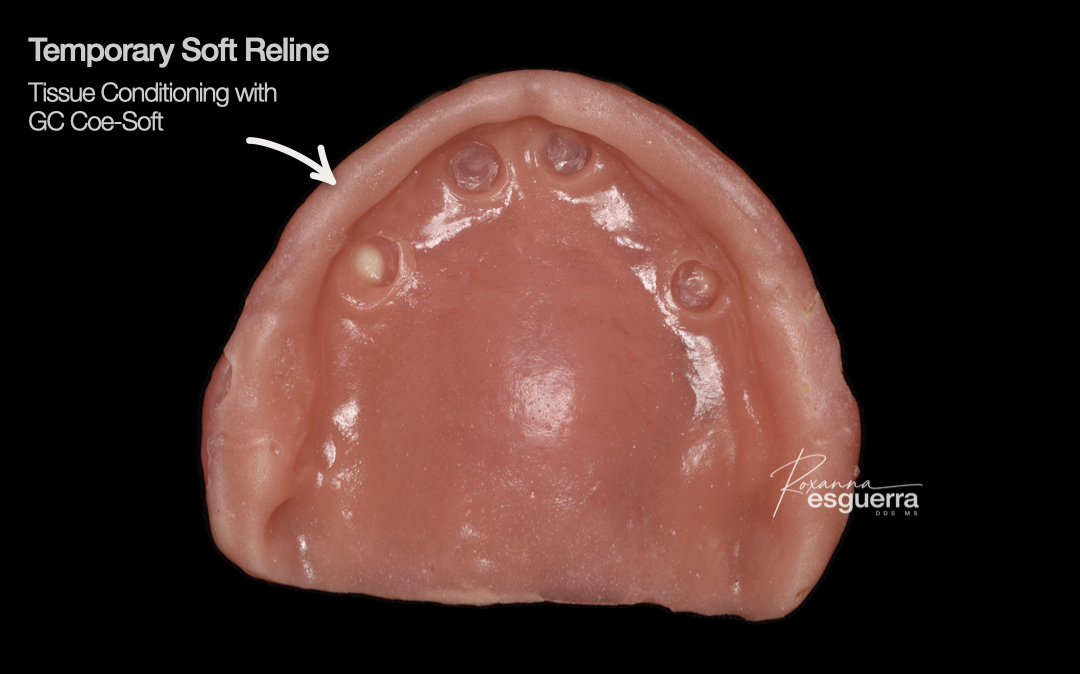
A temporary soft lining (shown above) on the surface that rests against the gums can improve adaptation and cushion irritated tissues. The lining is evaluated and replaced as needed.
Hard Relines for Complete Dentures
A hard reline restores the tissue-facing surface using a firm denture resin. It may be appropriate when the supporting tissues have changed but the denture remains otherwise serviceable. Dr. Esguerra evaluates tissue health, stability, bite, tooth wear, and the condition of the base before recommending treatment. For complete dentures, we offer two methods: (1) chairside hard relining and (2) laboratory hard relining.
What is a Chairside Hard Reline?
A chairside hard reline is performed in the office using a material that conforms to your tissues and hardens during the clinical procedure. The surface is then finished, and the fit and bite are checked. Convenience and lower cost are its principal advantages, and appropriate treatment can often be completed during the appointment. A chairside hard reline may also serve as an interim solution during a longer, multiphase implant treatment plan. Dr. Esguerra recommends it when these benefits fit your circumstances and the existing denture is suitable.
Chairside processing has limitations because the material is adapted and processed in the clinical environment. Saliva contamination can interfere with bonding, and the added material may differ in color from the existing pink denture base. Material compatibility also matters, as laboratory studies show that bonding performance varies with the combination of denture-base and reline materials.⁵ Dr. Esguerra considers these factors when deciding whether chairside treatment offers an appropriate result.
Why Choose a Laboratory Hard Reline?
For a laboratory hard reline, Dr. Esguerra makes an impression using your existing denture to record the supporting tissues. The laboratory renews the fitting surface under controlled conditions, followed by careful finishing and polishing. Dr. Esguerra typically recommends laboratory processing over a chairside hard reline because it avoids saliva contamination during processing and provides better control of bonding, surface quality, and color consistency. This preference reflects Dr. Esguerra’s clinical experience and our laboratory approach. The fit, tissue contact, and bite are checked when the denture is returned.
How Long Will I Be Without My Denture?
Many dental offices offer laboratory hard relines and repairs, but using an outside laboratory can mean up to two weeks without your denture. With our in-house dental laboratory, we can typically complete a laboratory hard reline in approximately three days, substantially shortening that time. We understand that being without your denture can feel unsettling and affect meals, conversations, and your confidence around others. Our team will help you prepare and work with you to make this period as manageable as possible.
The treatment sequence typically involves two to three scheduled visits, and your denture stays with us during the laboratory work. We encourage you to schedule your reline as soon as Dr. Esguerra recommends it, choosing treatment dates that work around your social events, travel, and other commitments rather than waiting until a problem becomes urgent. Our team coordinates the appointments and confirms when your denture will be returned. If you have saved a temporary denture, let us know so we can evaluate whether it could serve as a backup; see “Should I Keep My Temporary Denture as a Backup?” below.
Laboratory Hard Relines for Implant “Snap-In” Dentures
Dental implants can help preserve jawbone, but they do not prevent all changes in the bone and gums beneath a “snap-in” denture. Areas beyond the implants can continue to remodel, gradually changing the support provided by the tissues. Attachment components also wear over time, and changes in the bite or denture condition may require attention. Maintenance therefore begins with identifying the cause of the problem, rather than assuming that looseness always requires new inserts or a reline.
The two-implant lower “snap-in” denture is the design we most commonly evaluate for this type of relining. The implants provide attachment retention toward the front of the jaw, while the back portions of the denture continue to rely on the gums and underlying bone for support. As those tissues change, the denture may rock more than it previously did, even though it still snaps into place. Increased movement may also contribute to more frequent wear of the nylon inserts. Ask us about an evaluation if you notice increased rocking or inserts requiring more frequent replacement than previous.
Replacing inserts and relining the denture address different problems. New inserts can improve attachment retention, but they do not restore missing tissue support beneath the denture. A laboratory hard reline renews the fitting surface while accounting for the denture’s seating position and attachment components. After laboratory relining, the attachment housings must be secured again to the denture’s internal surface, a procedure called re-luting. This additional clinical step establishes their relationship to the implants before the final fit, bite, and attachment function are checked.
Our in-house laboratory typically allows approximately the same three-day turnaround for these relines, with housing reattachment coordinated as part of treatment. The benefit is an opportunity to improve tissue support while preserving an otherwise serviceable prosthesis. The limitations include time without the denture and the additional clinical procedures involving the attachments. Dr. Esguerra evaluates whether relining, insert replacement, other attachment maintenance, or a combination of treatments is appropriate.
How Often Is a Hard Reline Needed?
The need for a hard reline is determined by examination rather than the calendar alone. The American College of Prosthodontists reports that evidence does not establish one reline interval appropriate for every patient.² Based on Dr. Esguerra’s experience, patients with an upper complete denture made by Dr. Esguerra or Dr. Erickson can often expect consideration of a hard reline at approximately 8–10 years, provided the denture remains otherwise serviceable. This is a clinical expectation rather than a guarantee or a reason to postpone evaluation. Changes in comfort, fit, or function deserve assessment whenever they occur.
A lower implant “snap-in” denture made by Dr. Esguerra or Dr. Erickson may reach a similar point at approximately 8–10 years. Earlier evaluation is appropriate if it rocks more than before or its attachment inserts wear out more frequently. These changes can prompt Dr. Esguerra to recommend a reline after evaluating tissue support, the bite, and attachment function. They do not automatically establish that relining is the correct treatment. The recommendation depends on the findings and the overall condition of your prosthesis.
Should I Keep My Temporary Denture as a Backup?
We encourage patients to keep their temporary denture after receiving their final denture. It may provide a useful backup when the final denture must remain with us for a laboratory reline or other service. A backup may need evaluation or adjustment before use because your mouth can continue to change. Having it available can nevertheless make the period without your final denture easier to manage.
For long-term storage of temporary dentures, our office recommends freezer storage according to the instructions provided by our team. This is a practice recommendation based on Dr. Esguerra’s clinical experience, including observing temporary dentures preserved for many years. Proper cleaning and storage help avoid contamination and mold growth. Ask our team for preparation, storage, and return-to-use instructions before putting your temporary denture away.
When Is Relining the Right Choice?
A reline is most useful when the denture remains suitable and its principal problem is adaptation to the supporting tissues. Dr. Esguerra evaluates tissue health, support, stability, bite, tooth wear, and the condition of the denture base. For implant “snap-in” dentures, she also assesses seating and attachment components. Your comfort, appearance, treatment preferences, cost considerations, and time without the denture help guide the decision. Depending on the findings, an adjustment, repair, rebase, attachment maintenance, or new denture may provide a better result.¹˒²
Scientific References & Clinical Experience
Our recommendations combine published scientific guidance with Dr. Esguerra’s clinical judgment and 18 years of experience. The healing follow-up schedule, approximate 8–10-year expectations, laboratory processing preference, and temporary-denture freezer storage recommendation reflect our practice’s clinical approach. Laboratory turnaround estimates reflect our office’s workflow.
-
Felton D, Cooper L, Duqum I, et al. Evidence-based guidelines for the care and maintenance of complete dentures: a publication of the American College of Prosthodontists. Journal of Prosthodontics. 2011;20(suppl 1)–S12. doi:10.1111/j.1532-849X.2010.00683.x.
-
American College of Prosthodontists. Position Statement: The Frequency of Denture Replacement. Approved 2015; reaffirmed 2018.
-
Hasegawa Y, Minakuchi H, Nishimura M, et al. Effect of soft denture liners on complete denture treatments: a systematic review. Journal of Prosthodontic Research. 2024;68(4):493–510. doi:10.2186/jpr.JPR_D_23_00067.
-
Muddugangadhar BC, Mawani DP, Das A, Mukhopadhyay A. Bond strength of soft liners to denture base resins and the influence of different surface treatments and thermocycling: a systematic review. Journal of Prosthetic Dentistry. 2020;123(6):800–806.e6.
-
Awad AN, Cho SH, Kesterke MJ, Chen JH. Comparison of tensile bond strength of denture reline materials on denture bases fabricated with CAD-CAM technology. Journal of Prosthetic Dentistry. 2023;129(4):616–622. doi:10.1016/j.prosdent.2021.06.047.
-
Bidra AS, Daubert DM, Garcia LT, et al. Clinical practice guidelines for recall and maintenance of patients with tooth-borne and implant-borne dental restorations. Journal of Prosthodontics. 2016;25(suppl 1)–S40. doi:10.1111/jopr.12416.