
home care and professional maintenance in Duluth, MN
Complete Care Begins with Prevention
Keeping your mouth healthy takes more than repairing a tooth or replacing one that is missing. It means understanding why problems developed, controlling disease, and finding a daily routine that works for you.
Untreated tooth decay in permanent teeth is the world’s most common health condition. Severe gum disease affects more than one billion people worldwide and can destroy the support around teeth, eventually leading to tooth loss.[1] These conditions deserve attention before, during, and after restorative treatment.
At the Dental Implant & Reconstructive Center, prevention is central to the complete care philosophy. Dr. Roxanna J. Esguerra evaluates your individual risks and the health of your whole mouth. Treating one area while disease continues elsewhere would leave an important part of your care unfinished. Our goal is to help you preserve your natural teeth whenever possible—and protect the teeth, implants, and restorations you depend on.
Prevention Continues with Recare
Home care is what you do each day to support your oral health. “Recare” is the ongoing professional care that helps us monitor your health and treatment over time. Together, they create a plan that can adapt as your needs change.
That plan begins with a relationship. We learn what is manageable for you, show you where your efforts are working, and help with areas that need a different approach. At subsequent visits, we can compare findings, recognize changes, and anticipate maintenance needs. You have a team who knows your mouth, welcomes your questions, and cares about how you are doing years from now.
Explore your care
Protect the health you’ve worked for.
Whether you have natural teeth, dental implants, or a combination of both, we can help you understand the care your mouth needs.
What is My Risk of Cavities?
Caries is the clinical term for tooth decay. A caries risk assessment helps us understand your likelihood of developing new decay and what we can do to reduce that risk. It considers the balance between factors that promote disease and factors that protect your teeth.[2]
Dr. Esguerra uses a validated questionnaire, together with your clinical examination and X-rays, to assess low, medium, or high risk. The questionnaire takes approximately three minutes. Your findings guide recommendations for products, preventive treatment, and follow-up.
This approach draws on Caries Management by Risk Assessment, or CAMBRA, including research by Dr. Douglas Young at the University of the Pacific and collaborating researchers.[2] Dr. Esguerra incorporates risk assessment into every patient’s evaluation, with recommendations reflecting the teeth and restorations present.
The purpose is practical: to address the conditions causing disease, so your mouth has a better opportunity to remain healthy while treatment is completed and afterward.
What About Gum Disease?
Gingivitis is inflammation of the gums. Periodontitis involves damage to the tissues and bone supporting the teeth. As that support is lost, teeth may loosen and eventually be lost.[1]
Periodontal diagnosis considers more than whether gums bleed. The classification described by Armitage in 1999 helped establish a systematic approach to periodontal diseases.[3] The later staging-and-grading framework considers both how much damage has occurred and how the disease may progress.[4]
-
Stage describes severity and the complexity of managing the condition.
-
Grade considers evidence of progression and factors that influence future risk.
These distinctions help explain why two people may need different treatment and maintenance schedules. Daily care is important, but established periodontal disease also requires professional assessment and appropriate treatment.
Read more about periodontal disease.
Why Do Implants Need Care?
An implant cannot develop a cavity, but the gums and bone around it can develop disease. Peri-implant mucositis affects the surrounding soft tissues; peri-implantitis also involves loss of supporting bone.[5]
Daily cleaning and professional monitoring remain important even when every natural tooth has been replaced. The shape of your restoration, access around the implants, and your ability to clean effectively all influence your home-care plan.
We demonstrate techniques for your particular restoration and review them with you over time. The aim is an effective routine you can actually maintain.
Your home-care routine
Brushing
A manual toothbrush is a practical, cost-effective starting point. Dr. Esguerra teaches a gumline-focused approach based on the Bass technique, a longstanding method of personal oral hygiene.[6] Our team demonstrates the positioning and small, controlled movements so you can practice them yourself.
-
Use a soft-bristled toothbrush.
-
Angle the bristles approximately 45 degrees toward the gumline.
-
Use small, gentle circles, working systematically around your mouth.
-
Clean the outer, inner, and chewing surfaces of every tooth.
-
To reach the inside surfaces of the front teeth, turn the brush vertically and use gentle, controlled strokes.
-
Use light pressure rather than scrubbing harder.
Brush twice daily with the toothpaste recommended for your needs. For patients at high risk of decay, Dr. Esguerra may instruct you to spit out excess fluoride toothpaste without rinsing afterward.
If manual brushing is difficult, we can discuss an electric toothbrush. Dr. Esguerra generally prefers Philips Sonicare, although selected Oral-B products may also be appropriate. Electric brushes require a different technique; ask us to demonstrate how to use yours.
Flossing
Floss cleans between natural teeth where a toothbrush cannot adequately reach. How you guide and adapt the floss matters.
-
Start with approximately 18 inches of floss, wrapping most around your middle fingers.
-
Hold a short working section between your thumbs and index fingers, keeping your fingers close to the teeth for control.
-
Guide the floss gently through the contact. Avoid snapping it into the gums.
-
Curve it into a C-shape against one tooth, gently moving beneath the gum margin.
-
Move the floss up and down against that tooth, then adapt it against the neighboring tooth and repeat.
-
Advance to a clean section as you move around your mouth. Remember the back surface of the last tooth.
Floss selection depends on your contacts and restorations. Glide or POH floss may be helpful around porcelain crowns or tight contacts.
If you are beginning to floss after a long break, inflamed gums may bleed initially. Bleeding that persists beyond two weeks needs a dental evaluation. Contact us sooner if you have pain, swelling, or other concerns.
Bridge Threaders
A fixed bridge connects replacement teeth together, so floss cannot pass between them in the same way it passes between separate natural teeth. A bridge threader helps guide floss beneath the connected restoration.
Thread the floss under the bridge, then use the technique our team demonstrates to clean the supporting teeth or implant components and the underside of the restoration. Access and technique differ among bridges and full-arch restorations, so ask us to show you where and how to clean yours.
If the floss repeatedly catches, shreds, or cannot pass through an area, let us know. We can assess the access and help select another tool or technique.
Water Flossers
A water flosser can be a useful addition when cleaning around bridges, implant restorations, and areas that are difficult to reach. It supplements brushing and the other cleaning methods selected for your mouth.
If you are deciding where to invest in a home-care device, Dr. Esguerra generally prioritizes a water flosser over upgrading from a manual to an electric toothbrush. For frequent travelers, she also recommends a portable or cordless model to help maintain the routine away from home.
Dr. Esguerra recommends a medium setting—never high. Ask our team for individualized guidance on tip selection, positioning, and use around your restoration.
Sensitive Teeth
Sensitivity can have different causes, and the appropriate treatment depends on the diagnosis.[7]
-
Tooth decay or disease affecting the pulp: The living tissue inside a tooth may require treatment. Sensitivity should not automatically be treated as a toothpaste problem.
-
Exposed dentin: Gum recession can expose root surfaces, while acid erosion and tooth wear can expose dentin elsewhere on the tooth.
A desensitizing toothpaste may help when exposed dentin—particularly exposed roots—is responsible. It does not treat a cavity or pulpal disease. Tell us about new, persistent, or changing sensitivity so we can evaluate the cause and recommend appropriate care.
Choosing Home-Care Products
The best regimen depends on your cavity risk, gum health, restorations, and ability to use the products effectively. A product that suits one patient may not meet another patient’s needs.
For patients at high risk of tooth decay, we carry specialized rinses selected as part of a disease-control plan. You may choose a store-bought alternative, but products differ in their ingredients, concentrations, and intended effects. Bring the label so we can explain whether it provides the protection your plan requires.
Follow your individualized instructions for toothpaste, rinses, and their timing. Ask us before substituting products if you are unsure how they compare.
Preference for Natural Products?
Your preferences matter. If you prefer natural products, bring the product itself, photographs, or a clear image of the ingredient label.
We can review it with you and help select a regimen that respects your values while addressing your clinical needs. The conversation should include what the product contains, what it is intended to do, and whether anything else is needed to protect your mouth.
Dry Mouth
Saliva helps protect your teeth and keeps oral tissues comfortable. When saliva is reduced, it can become more difficult to control decay or tolerate a restoration comfortably.
Tell us about persistent dryness and any changes in medications or health. We can review how dry mouth affects your care and discuss appropriate preventive products and strategies. Your recommendations may differ from those given to someone with normal saliva flow.
Visit our Dry Mouth page for more information.
Nutrition
What you eat and drink—and how often—affects your oral environment. Plaque bacteria use sugars to produce acids that can damage teeth.[1] Frequent sipping or snacking can create repeated exposures throughout the day.
-
Make water your usual drink, particularly between meals.
-
Discuss frequent sugary snacks, sweetened drinks, or prolonged sipping with our team.
-
Tell us if discomfort or difficulty chewing limits the foods you can eat.
-
If dry mouth leads you to use lozenges or other products frequently, bring the packaging so we can review them.
Our recommendations should fit your health, daily routine, and nutritional needs. Your diet is part of understanding your mouth—not an occasion for judgment.
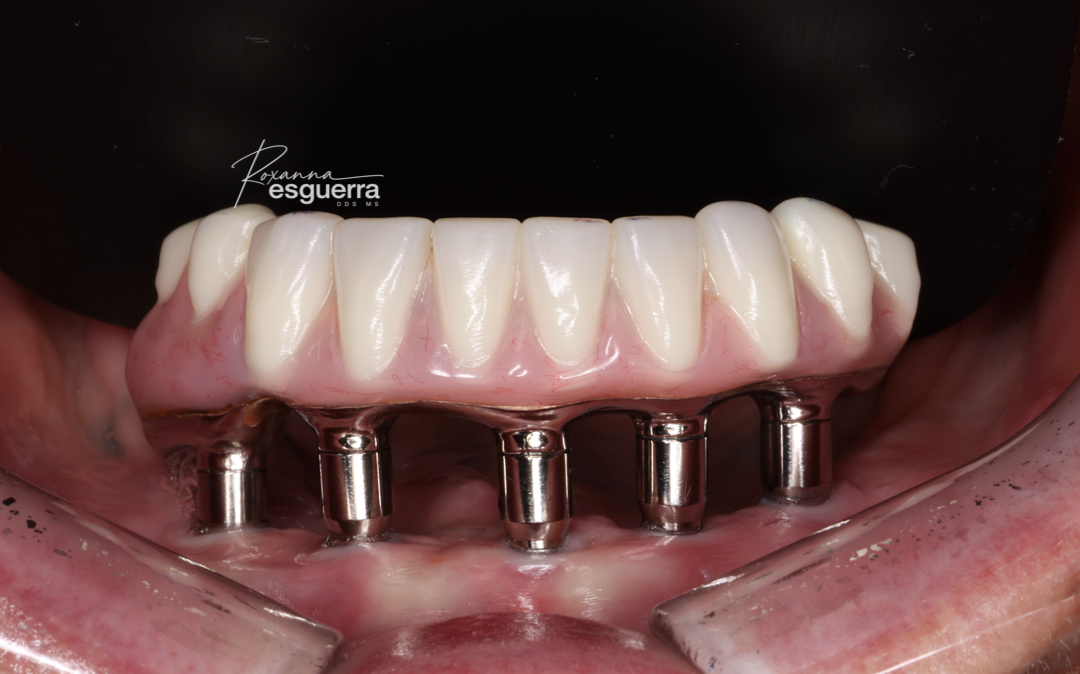
Fifty Years of Daily Care
This patient has lived with her dental implants for 50 years. Her meticulous home care is reflected in the exceptionally healthy gum tissues around them. This close-up shows the access beneath her fixed restoration that allows her to clean around each implant. Several years ago, we refurbished the acrylic using the existing metal framework. But the investment in daily home care is truly what creates a lasting result.
Recare: Your ongoing care
What Happens at Recare?
Recare is your regular maintenance visit with Dr. Esguerra. It is an opportunity to assess how your mouth and reconstruction are functioning and to help you care for them over time.
Depending on your needs, the visit may include:
-
Reviewing your health and concerns, including changes in medications, comfort, or function.
-
Evaluating home care: Identifying where cleaning is effective, where deposits remain, and what would help.
-
Monitoring tissues and bone: Assessing the gums and implant tissues, with X-rays when indicated to evaluate supporting bone and other findings.
-
Checking your bite and restoration: Reviewing wear, fit, condition, and signs of developing problems.
-
Reviewing your nightguard: Checking its condition, fit, and use when applicable.
-
Assessing maintenance needs: Such as retentive inserts on removable implant dentures or screw-access seals on fixed restorations.
-
Examining your oral tissues, including an oral cancer screening.
Professional cleaning with our licensed dental hygienist may accompany the visit. The specialist examination, home-care coaching, and cleaning are distinct parts of your care.
We explain what we see, what you can improve at home, and what intervention may help prevent a developing issue from becoming an emergency.
How Often Should I Return?
Dr. Esguerra generally recommends a specialist recare examination approximately once a year, with timing adjusted to your findings and treatment.
Hygiene or maintenance visits may be needed more frequently. Your schedule depends on your natural teeth, periodontal history, implant tissues, restoration, home-care effectiveness, and other risk factors. Published implant-care guidelines support individualized professional monitoring and maintenance.[5]
Some patients receive their ongoing dental care here; others combine specialist recare with visits to their general dentist. We explain the recommended arrangement and the purpose of each visit.
Do My Implants Need to be Removed for Cleaning?
Usually, patients asking this question mean removing the fixed restoration attached to the implants, not removing the implants from the jawbone. This is sometimes called “Removal Cleaning.”
Removing a fixed restoration for cleaning is a specialized maintenance procedure that must be evaluated and treatment planned. It is not automatically part of every cleaning or recare visit.
Dr. Esguerra may consider removal when cleaning remains ineffective despite coaching and consistent effort, or when calculus buildup requires access that cannot otherwise be obtained. Arthritis, limited dexterity, or cognitive and memory difficulties may also affect what a patient can manage at home and influence the maintenance plan.
For an existing patient, an inquiry about removal cleaning can be relayed to Dr. Esguerra for review of previous findings or added to the next examination as a request for evaluation. Tell our team before scheduling, because removal cleaning requires specific appointment arrangements and additional fees.
If you are new to our practice, we begin with a consultation before recommending specialized maintenance. Please tell us you have existing implants and review the implant-records information on Patient Registration.
No Natural Teeth Left—Do I Still Need a Dentist?
Yes. Even without natural teeth, your gums, oral tissues, implants, and restorations need attention.
A denture can change in fit or develop wear and damage. Implant restorations have components that may need maintenance, and the surrounding tissues require monitoring.[5] An examination also gives us an opportunity to assess your oral tissues and perform an oral cancer screening.
Continued care helps us recognize changes and address maintenance needs before they become more disruptive.
Care Instructions and Downloads
Use the instructions specific to your restoration, together with the individualized guidance provided by our team:
Ask our team for the current care sheet for your restoration. If written instructions and your personal recommendations differ, contact us for clarification.
Scientific References
The guidance on this page combines published research with Dr. Esguerra’s clinical protocols. Product selection, water-flosser settings, recare intervals, and decisions about restoration removal are individualized recommendations rather than universal instructions for every patient.
-
World Health Organization. Oral health. Updated March 17, 2025.
-
Young DA, Featherstone JDB. Caries management by risk assessment. Community Dent Oral Epidemiol. 2013;41(1)–e63.
-
Armitage GC. Development of a classification system for periodontal diseases and conditions. Ann Periodontol. 1999;4(1):1–6.
-
Tonetti MS, Greenwell H, Kornman KS. Staging and grading of periodontitis: Framework and proposal of a new classification and case definition. J Periodontol. 2018;89(Suppl 1)–S172.
-
Herrera D, et al. Prevention and treatment of peri-implant diseases—The EFP S3 level clinical practice guideline. J Clin Periodontol. 2023;50(Suppl 26):4–76.
-
Bass CC. An effective method of personal oral hygiene. J La State Med Soc. 1954;106(2):57–73.
-
Felix J, Ouanounou A. Dentin hypersensitivity: Etiology, diagnosis, and management. Compend Contin Educ Dent. 2019;40(10):653–657.
Let’s Plan for Your Long-term Oral Health.
A useful care plan fits your mouth, your abilities, and your life. We will help you understand what to do at home and what professional care to arrange.
Contact our team or call 218-722-8118.