
SAME-DAY TEETH & IMMEDIATE LOADING Duluth MN
Replacing Your Teeth With Dental Implants
If your remaining teeth are breaking down and you are considering replacing them with dental implants, understanding the transition matters. What happens when your teeth are removed? When are the implants placed—and what will your smile look like while you heal?
At the Dental Implant & Reconstructive Center, Dr. Roxanna J. Esguerra plans both the removal and replacement of your teeth as part of one coordinated treatment plan. For suitable patients replacing all the teeth in the upper or lower jaw, the remaining teeth can be removed and implants placed at the same appointment. This is called immediate implant placement. Your plan also includes temporary replacement teeth to carry you through healing.
Will I Be Without Teeth?
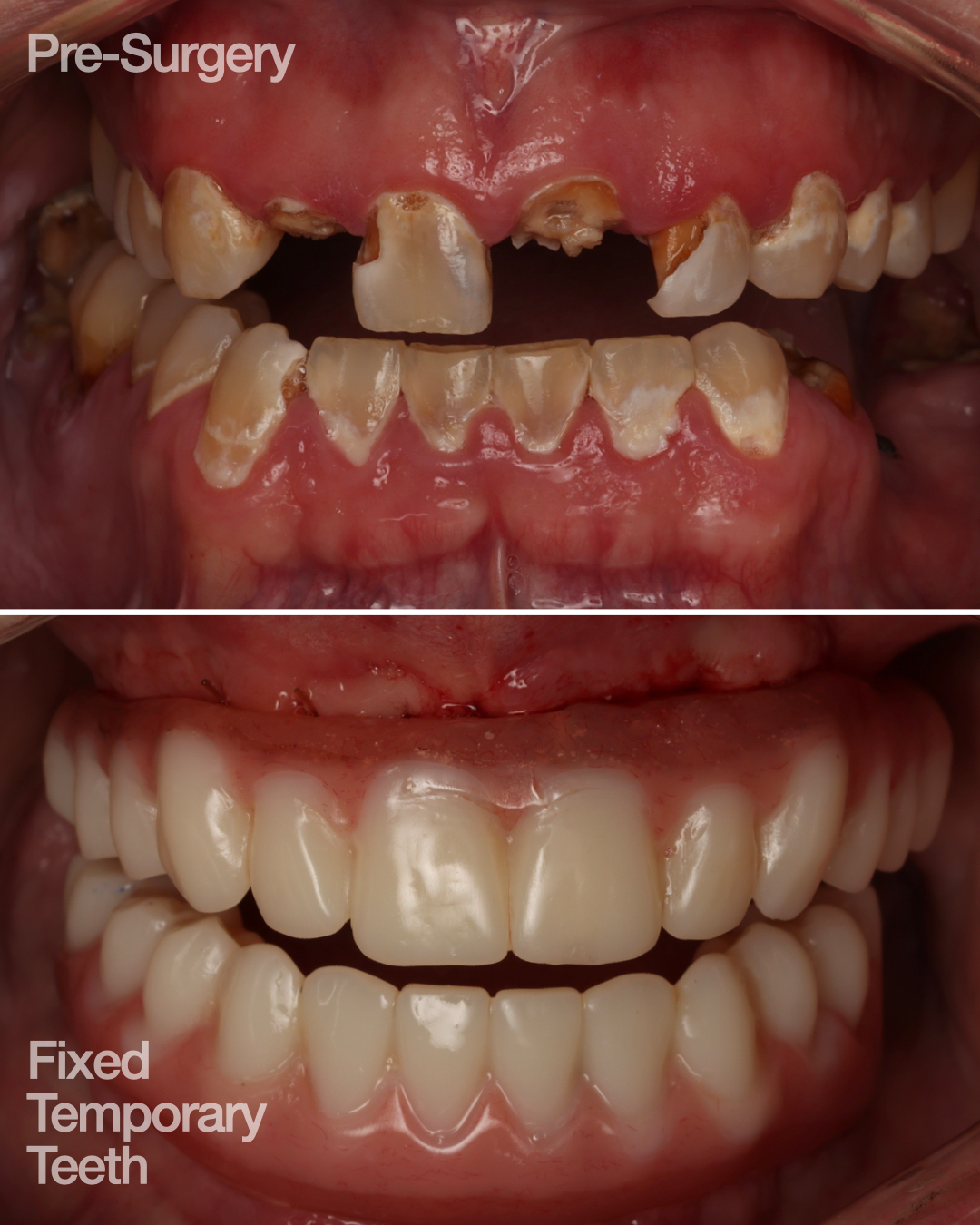
No. Before surgery, we plan the temporary replacement you will use while your mouth heals. For suitable patients, the remaining teeth are removed, dental implants are placed, and a connected set of temporary teeth is attached in one day.
These are two distinct steps: immediate implant placement means placing implants at the time of tooth removal; immediate loading means attaching replacement teeth to those newly placed implants. Together, they make what is often called “same-day teeth” possible.
Dr. Esguerra uses three-dimensional imaging and a custom surgical guide to help transfer the planned implant positions to surgery.[3]
Your fixed temporary teeth stay in your mouth while the implants heal. They restore your smile during treatment, with eating restrictions to protect the healing implants. Your final replacement is made later.
If the implants are not sufficiently stable to support fixed temporary teeth, we provide a temporary removable denture instead. Both possibilities are discussed before surgery, so you understand how your smile will be restored throughout treatment.
Smile Without Hesitation
Feel Good About Your Smile Again!
When Will I Know If I Can Have Fixed Temporary Teeth?
We understand how important your teeth are to your everyday life. Fixed temporary teeth help restore your smile and speech, provide reassurance during the transition, and connect the implants to support healing. Dr. Esguerra’s approach is to accomplish as much as safely and predictably possible in a coordinated course of care, using established treatment guidelines.[1,2]
Whether immediate loading is appropriate is determined during surgery, based on:
-
Implant stability: how securely the implants are held in your bone when placed.
-
Your bone: its quality, amount, and location.
-
Implant arrangement: how the implants work together to support the temporary replacement.
-
Your bite: the forces acting on the replacement, including grinding or clenching.
-
Your health and recovery: factors affecting healing and your ability to follow dietary and home-care instructions.[1,2,4]
Immediate loading is generally more predictable in the lower jaw; the upper jaw requires particular consideration of bone quality and implant support.[1,5] Planning prepares for both pathways, so Dr. Esguerra can respond to what she finds with your long-term result guiding each decision.
If the implants need to heal before fixed teeth are attached, we provide a temporary removable denture. Whichever approach best supports your healing, you will have replacement teeth and continued guidance and care from our team.
What Should I Expect From My Temporary Teeth?
Treatment involving extractions, implant placement, and a fixed temporary replacement is an all-day procedure in our practice. Your temporary replacement helps restore your appearance and speech while the implants heal. It is deliberately thicker than the final design to provide strength during this stage, so its shape and feel will take some adjustment. Changes in speech, such as a slight lisp, often improve with practice.
Fixed does not mean ready for normal chewing. Our immediate-loading protocol requires a no-chewing diet to protect the healing implants and temporary replacement. Foods should require no biting or grinding; examples include smooth soups, yogurt, mashed potatoes, and other foods prepared to a suitable consistency.
During this stage:
-
Avoid biting with your front teeth, including into sandwiches or whole fruit.
-
Avoid crunchy, tough, sticky, or chewy foods.
-
Follow your individual cleaning instructions and attend your postoperative reviews, routinely at approximately ten days and one month.
-
Contact us promptly if the replacement feels loose, cracks, or your bite changes. Temporary replacements and their connecting components can develop complications that require attention.[5]
Dr. Esguerra will tell you when dietary restrictions can change. Feeling comfortable is not, by itself, a sign that the implants are ready for greater chewing forces.
When Will I Receive My Final Teeth?
Dental implant treatment involves a significant commitment of time and money. You deserve a final result developed with care, and the design of your definitive—final—replacement teeth is an essential part of that process.
Your temporary teeth give us a reference point: what you like, how they feel, and what we want to refine. After approximately four to six months of implant healing, we begin developing your final replacement through several try-ins—appointments to evaluate a trial version before the final teeth are made. Together, we assess how the teeth align with your face, how your lips move around them during speaking and smiling, and whether your bite feels balanced and comfortable. Small refinements at this stage help bring those details together.
You can expect to use your temporary teeth for approximately ten to twelve months, allowing time for healing and the careful development of your final replacement. You may have seen advertisements offering final teeth in just two days, and some patients choose that approach. If you value being involved in the design, experiencing it before it is finalized, and refining even the smallest details, our approach provides that opportunity. Your smile deserves that degree of consideration.
Scientific References
-
Papaspyridakos P, Chen CJ, Chuang SK, Weber HP. Implant loading protocols for edentulous patients with fixed prostheses: A systematic review and meta-analysis. Int J Oral Maxillofac Implants. 2014;29(Suppl):256–270.
-
Gallucci GO, Benic GI, Eckert SE, et al. Consensus statements and clinical recommendations for implant loading protocols. Int J Oral Maxillofac Implants. 2014;29(Suppl):287–290.
-
Tahmaseb A, Wu V, Wismeijer D, Coucke W, Evans C. The accuracy of static computer-aided implant surgery: A systematic review and meta-analysis. Clin Oral Implants Res. 2018;29(Suppl 16):416–435.
-
Chen J, Cai M, Yang J, Aldhohrah T, Wang Y. Immediate versus early or conventional loading dental implants with fixed prostheses: A systematic review and meta-analysis of randomized controlled clinical trials. J Prosthet Dent. 2019;122(6):516–536.
-
De Bruyn H, Raes S, Östman PO, Cosyn J. Immediate loading in partially and completely edentulous jaws: A review of the literature with clinical guidelines. Periodontol 2000. 2014;66(1):153–187.