Pre-prosthetic Surgery Duluth MN
Preparing the Foundation for Restorative and Implant Treatment
Pre-prosthetic surgery includes surgical procedures performed to prepare the teeth, bone, and soft tissues for a planned dental restoration. Depending on the treatment, this may involve preparing the mouth for a conventional denture, an implant-assisted removable denture, or an implant-supported restoration.
The goal is not simply to perform a surgical procedure. The goal is to create the appropriate foundation for the restoration that will ultimately replace the missing teeth.
WHAT IS PRE-PROSTHETIC SURGERY?
The shape and condition of the underlying bone and soft tissues can directly affect the fit, function, cleansability, and design of a dental prosthesis.
After a tooth is removed, the remaining bone may be sharp, uneven, or shaped in a way that interferes with the planned restoration. In other situations, there may not be enough bone in the appropriate location for dental implant placement. Soft tissues may also require management to create a healthier or more favorable restorative environment.
Pre-prosthetic surgery addresses these conditions with the planned restoration in mind.
PLANNING SURGERY AROUND THE FINAL RESTORATION
One of the most important principles in prosthodontic treatment is to begin with the desired restorative outcome and work backward.
Before surgery, Dr. Roxanna J. Esguerra evaluates what teeth are being maintained or replaced, the type of restoration being considered, the available bone and soft tissue, and how the final prosthesis will need to function.
For implant treatment, this is particularly important. The presence of available bone alone does not determine where an implant should be placed. Implant position can affect the design, function, esthetics, cleansability, and long-term maintenance of the final restoration.
When appropriate, clinical examination, photographs, digital impressions, and CBCT imaging can be combined to plan the surgical and restorative phases of treatment together.
COMMON PRE-PROSTHETIC PROCEDURES
Depending on the individual treatment plan, pre-prosthetic surgery may include:
- Tooth extraction
- Smoothing or reshaping of the jawbone (alveoloplasty)
- Removal of excess bone.
- Bone ridge reduction.
- Removal of excess gum tissue.
- Exposure of impacted teeth.
- Grafting of bone on the jaw ridge.
- Grafting of bone at the base of the maxillary sinus.
- Placing of dental implants.
Not every patient requires these procedures, and the appropriate treatment depends on the existing anatomy and the type of restoration being planned.
PRE-PROSTHETIC SURGERY FOR DENTURES
A removable denture rests on and receives support from the tissues underneath it. The contour of the underlying bone and soft tissue therefore matters.
When teeth must be removed before a denture is made, selective reshaping of sharp or irregular bone may sometimes be appropriate. In other situations, preserving available bone is more important. The amount and location of any bone reduction should therefore be determined by the planned prosthesis and the individual clinical situation, rather than performed routinely.
For patients receiving an immediate denture on the day teeth are removed, surgical planning also considers the temporary prosthesis that will be worn during healing and how the tissues are expected to change afterward.
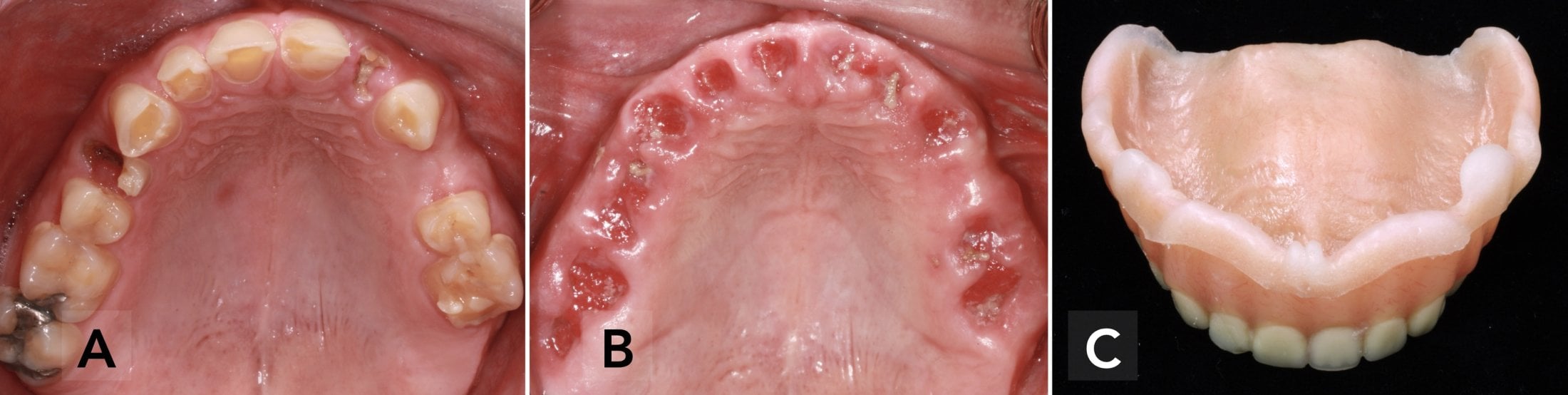
Clinical example of pre-prosthetic treatment: existing maxillary dentition (A), healing after tooth removal (B), and the immediate denture used during healing (C).
PRE-PROSTHETIC SURGERY FOR DENTAL IMPLANTS
Implant treatment adds another consideration: the supporting bone and soft tissue must accommodate not only the implant, but also the restoration that will eventually be connected to it.
In some cases it may be necessary to graft bone for the placement of dental implants first, and then place implants to support the future denture, crown, or bridge.
Depending on the patient’s anatomy and treatment goals, preparation may include tooth removal, bone grafting, sinus augmentation, bone or soft-tissue modification, and implant placement.
Three-dimensional CBCT imaging and digital treatment planning may be used to evaluate the relationship between available anatomy, proposed implant position, and the planned restoration. For selected cases, this information can also be used to design a surgical guide to help transfer the digital plan to the clinical procedure.
WHY PROSTHETIC PLANNING COMES FIRST
Surgery and prosthetic treatment should not be viewed as unrelated steps.
A technically successful surgical procedure can still create restorative challenges if the needs of the final prosthesis were not considered during planning. Conversely, understanding what the final restoration needs to accomplish can help guide decisions about tooth removal, bone preservation or augmentation, implant position, and tissue management.
As a prosthodontist whose practice includes both the surgical and restorative phases of treatment, Dr. Esguerra plans these procedures as connected parts of the same treatment process.
The objective is straightforward: plan the foundation around what ultimately needs to be built.
QUESTIONS ABOUT PRE-PROSTHETIC SURGERY?
If you have been told that you need extractions, bone grafting, implant surgery, or another procedure before your teeth can be restored, we can evaluate both the surgical needs and the restoration being planned.
Our team is happy to help answer your questions.
Let Us Fit Your Prosthetic!
Our caring staff is here to help you if you have any questions!