
Denture Care in Duluth, MN
At the Dental Implant & Reconstructive Center, denture care brings together the expertise of Dr. Roxanna Esguerra, a board-certified prosthodontist, the technical skill of our in-house dental laboratory, and a caring, knowledgeable team. We help you care for your denture with practical guidance tailored to its materials, fit, and your oral health.
Daily cleaning protects your denture’s surfaces and helps maintain a healthy mouth.¹˒² These instructions apply to removable complete dentures, partial dentures, and implant snap-on dentures. After surgery or placement of a soft lining, follow the specific instructions provided by our team.
These guidelines cover daily care for complete dentures, partial dentures, and implant snap-on dentures. If you have recently had surgery or your denture has a soft lining, follow the individualized care instructions provided by our team.
Your Daily Care Routine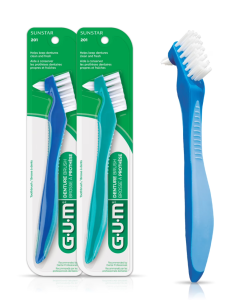
-
Remove your denture before bed.
Unless Dr. Esguerra has instructed otherwise, leave your denture out while you sleep. This gives your gums a break from denture coverage and helps reduce inflammation associated with continuous wear.¹ -
Protect it while cleaning.
Place a folded washcloth or hand towel in the sink to cushion an accidental drop. Use cool or lukewarm water—never very hot or boiling water.¹ -
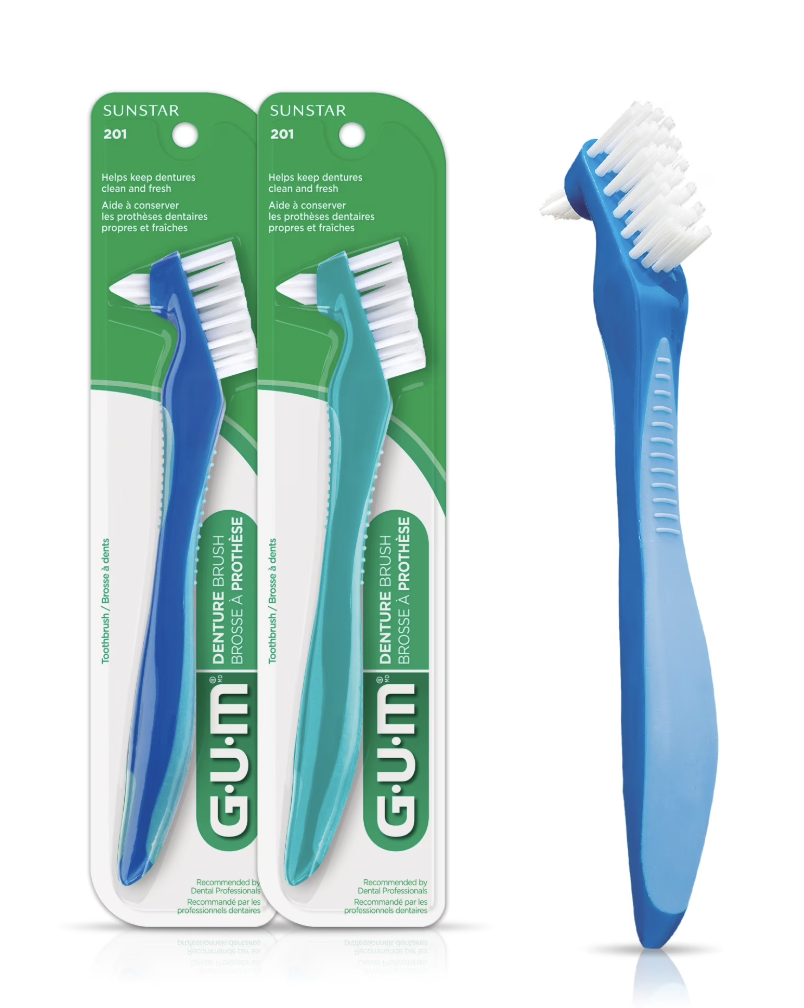
Brush every surface gently.
Use a soft denture brush with a low-abrasive, non-whitening toothpaste for sensitive teeth recommended by our team, or mild liquid soap. Clean the teeth, gum-colored surfaces, and internal surface that rests against your gums. Carefully clean around any metal framework and attachments. Remove any adhesive and rinse thoroughly. -
Clean your mouth, too.
Gently clean your tongue, palate, and gums with a soft toothbrush. Brush natural teeth twice daily with fluoride toothpaste and clean between them. If you have implant snap-on dentures, clean around the implants and attachments using the tools demonstrated by our team. -
Store your clean denture as instructed.
Unless we have provided different instructions, keep your denture in fresh, cool water when you are not wearing it. Clean the storage container daily and replace the water each time. Plain water is for storage—it does not disinfect your denture.¹˒⁶
Can I Use Toothpaste on My Denture?
Our office recommends a low-abrasive, non-whitening toothpaste formulated for sensitive teeth, based on decades of clinical experience caring for denture patients by Drs. Esguerra and Erickson. **Mild liquid soap, such as dishwashing liquid, is an alternative for daily brushing.**¹
Choose the specific product recommended by our team, since toothpaste formulations vary. Avoid whitening toothpaste, abrasive powders, and stiff brushes. Laboratory research shows that brushing acrylic with dentifrices can increase surface roughness and material loss, making gentle cleaning and product selection important.³
Should I Soak My Denture in a Cleaning Solution?
A compatible denture cleanser can supplement brushing, but follow the recommended soaking time. Research supports combining mechanical cleaning with an appropriate chemical cleanser to reduce microbial buildup.²
Do not assume every product is safe for every denture. Metal frameworks, soft linings, and implant attachments may require different care. Avoid household bleach or homemade cleaning mixtures unless we have specifically prescribed a cleaning protocol.
Leave your denture in a cleaning solution overnight only if the product is intended for overnight use and is appropriate for your prosthesis. Longer soaking is not necessarily better. Always rinse thoroughly before placing the denture back in your mouth.¹
Cleaning and storage are separate steps. Research suggests that overnight dry storage may be appropriate for certain complete dentures, but storage instructions should be selected for your particular prosthesis. Follow our recommendations rather than changing your routine based on general advice.⁶
Is an Ultrasonic Cleaner Helpful?
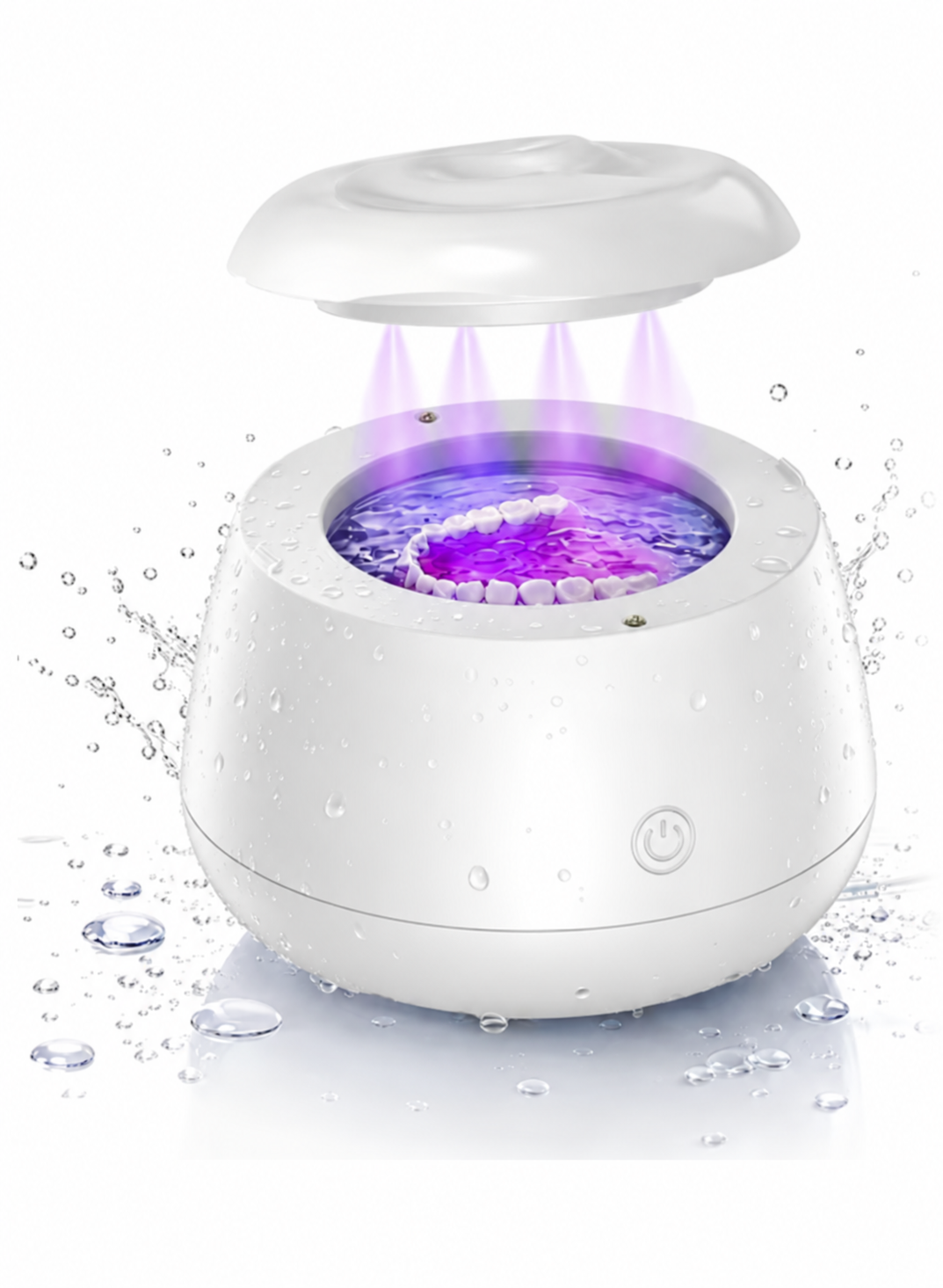
Yes—a home ultrasonic cleaner can be a useful addition to your routine.
Ultrasonic devices use vibrations in liquid to help loosen deposits from denture surfaces. Clinical research supports their use, particularly with a compatible denture-cleaning solution. They may be especially helpful when limited hand strength or dexterity makes thorough brushing difficult.⁴˒⁵
Ask our team which device and solution are appropriate for your denture. Follow the recommended cleaning cycle, rinse the denture afterward, and clean the device’s container after use. Continue cleaning your mouth and attending regular dental visits.
Why Should I Leave My Denture Out at Night?
Continuous denture wear is associated with denture stomatitis—inflammation of the tissues beneath a denture. Removing your denture at bedtime provides a regular break from coverage and an opportunity to clean both your mouth and the prosthesis.¹
In a study of adults aged 85 and older, sleeping in dentures was also associated with a higher risk of pneumonia. This finding reinforces the importance of overnight removal and good hygiene, particularly for older adults.⁷
If you have just had extractions, your initial wearing instructions may be different. Follow the postoperative directions provided by Dr. Esguerra.
When Should I Contact the Office?
Contact us if you notice:
-
Persistent soreness, redness, or burning.
-
A change in fit, stability, or your bite.
-
Cracks, a loose denture tooth, or a damaged clasp.
-
Increasing reliance on denture adhesive.
Do not file, bend, or glue your denture yourself. Have it evaluated so we can identify the cause and recommend the appropriate adjustment or repair.
Continue regular dental visits even if you no longer have natural teeth. We assess your oral tissues, denture fit, bite, wear, and any implant attachments to help maintain comfort and function.¹
Questions about a cleaning product or ultrasonic device? Bring it—or a photograph of its label—to your next appointment.
Scientific References
-
Felton D, Cooper L, Duqum I, et al. Evidence-based guidelines for the care and maintenance of complete dentures: a publication of the American College of Prosthodontists. Journal of Prosthodontics. 2011;20(suppl 1)–S12. doi:10.1111/j.1532-849X.2010.00683.x.
-
Schmutzler A, Rauch A, Nitschke I, Lethaus B, Hahnel S. Cleaning of removable dental prostheses—a systematic review. Journal of Evidence-Based Dental Practice. 2021;21(4):101644. doi:10.1016/j.jebdp.2021.101644.
-
Campos DES, Ferreira Muniz ÍA, da Costa TKVL, et al. Effect of simulated brushing with dentifrices on surface roughness and the mass loss of acrylic resin: a systematic review and meta-analysis of in vitro studies. The Journal of Prosthetic Dentistry. Published online August 21, 2023. doi:10.1016/j.prosdent.2023.06.027.
-
Lim TW, Burrow MF, McGrath C. Efficacy of ultrasonic home-care denture cleaning versus conventional denture cleaning: a randomised crossover clinical trial. Journal of Dentistry. 2024;148:105215. doi:10.1016/j.jdent.2024.105215.
-
Lim TW, Lee J, Ab Ghani SM, Burrow MF, McGrath C. Ultrasonic cleaning and its effects on denture biofilm: a systematic review. International Dental Journal. 2025;75(6):103921. doi:10.1016/j.identj.2025.103921.
-
Verhaeghe TV, Wyatt CC, Mostafa NZ. The effect of overnight storage conditions on complete denture colonization by Candida albicans and dimensional stability: a systematic review. The Journal of Prosthetic Dentistry. 2020;124(2):176–182. doi:10.1016/j.prosdent.2019.07.014.
-
Iinuma T, Arai Y, Abe Y, et al. Denture wearing during sleep doubles the risk of pneumonia in the very elderly. Journal of Dental Research. 2015. doi:10.1177/0022034514552493.
Questions About Your Denture?
For cleaning guidance, sore spots, changes in fit, or repairs, call to schedule.